
“If you think of what we’re all going to encounter in the next ten, twenty years, in terms of environmental devastation, which we know is gonna happen, it’s very much a kind of moving towards accepting and being—how to be with that, rather than any kind of tuning out.” (Blanc Sceol)
At the start of my research into ecocentrism I felt like I was about to discover a whole new world. One that knows how to live interconnectedly and biodiverse, away from monoculturistic ways of existing and ‘being well’ in a world built on separations. What was I hoping to find out? Oh, just the best way to live as one with nature! But does that mean the same to everyone? Is that perhaps a synonymous idea to popular notions of how to ‘be well’? And where does that leave us when things aren’t well?

A romantic notion
I was excitedly planning my excursions abroad to attend activities immersed in nature and interview people that had found their own niche in the ecocentric field. The idea was romantic, but I also had my doubts whether it was a world too separate from ‘reality’—being a standard day to day existence in modern Western society. After my second week of travelling through and away from the city to venture to nature spaces, both large and small, I realised that my research expanded far beyond these timed excursions. Sitting in a noisy, smelly, over-peopled bus, I sat there, all my senses heightened by a sonic meditation, realising how disgustingly connected I felt to everything and everyone around me sharing a late night bus ride through London. Our combined breath was dripping off the cold windows: air and water expelled through mouths and pores. How naive to think that my own way of being in the world—every part of it!—wouldn’t fundamentally change. I had, essentially, made an experiment out of myself.
Interviewing people and placing myself in various situations as both observer and participant (are we ever not participating?) has righted my romanticised view. My search is now dedicated to showing how other ways of perceiving and sense-making are not limited to nature retreats and artists, and that connection can be found anywhere. Which is already proving extremely difficult. Partially because this journey is a sensuous and experiential one, often non-verbal, whereas for my academic research I am limited to written verbal language. One of the main things I have learned these past months is how much of a difference we all make in the world, and of the world, and that together these very subjective experiences weave an interconnected reality that perhaps knows no perfectly objective truth we should all strive for. Promising is that beyond the fear and pain that environmental destruction will brings us we can learn to accept our fast-changing realities, with all its discomforts and beauty, and perhaps make the most of it.
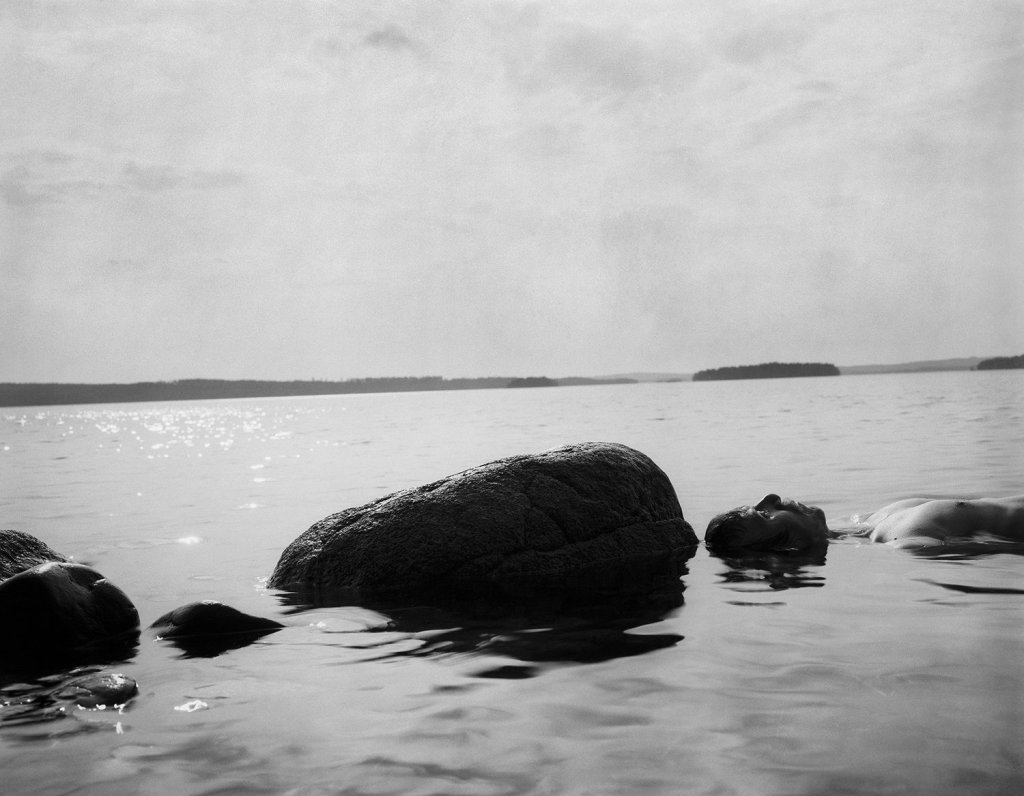
Connection
A main theme that is repeatedly coming up is connection, defined and felt in a multitude of ways. Ecotherapy facilitators and artists I meet are combining forms of inner gazing with connecting to their surroundings. If you are comfortable with abstractions, I have been calling this an ’inside out/outside in’ approach, whereas both directions may have you end up in the same spot eventually. In holistic terms this is perhaps the manifestation of everything being connected, where we are and shape our environment as much as it shapes us. Let’s call this cosmic connection.
Connection to the environment is, of course, an essential aspect. Whatever locality is chosen for an ecotherapy or eco-art event, time is usually dedicated to ground and tune in to the surroundings with help of our bodies and senses. Sounds, smells, sights and textures that are present play an important role in shaping activities and experiences on the spot. And this is a reciprocal thing. Where we are perceiving our surroundings, our surroundings are similarly perceiving us being temporarily part of their ecosystem.
Another form is how connected we feel with our emotions, or internal world, singled out. Participants in ecotherapy groups have shared to be grappling with heavy themes, like ageing and death. It was incredibly powerful to see that without intellectually picking apart their brains, people were able to express and process complex emotions. The telling of old myths and stories offered lessons that were subjectively interpreted and applied to their personal situation. Searching for natural elements that for people symbolised similar themes could help place their problems in perspective to the broader scheme of life, and recognise that they are not really alone, but always held by nature.
There is a deepened sense of connection between everyone present as well. Sharing complete openness without expectations can be an allowing or even healing experience. Learning to sit with your feelings, however they come, is something not many people are good at. We tend to find it difficult to share emotions like grief, fear or guilt, and if we could, we would magic them away without inquiring into what they may be able to tell us. There is resilience to be built when we learn to allow ourselves to feel and share both uplifting and difficult emotions, which is important for both mental health and social connection.
And then, in all this, there also exists a strong connection to the present. Which is where all healing happens. Mindfulness and conscious activities anchor us not only to our surroundings, but also to the present moment. Again, the breath and senses play a huge part in this. It’s only our mind that can live in a time outside of the present moment, busying itself with past and prospective events. Tuning into other parts of ourselves allows the mind some rest, and trains it to become a guiding servant instead of our main operating chamber. There is much in life that beckons to be sensed and witnessed.
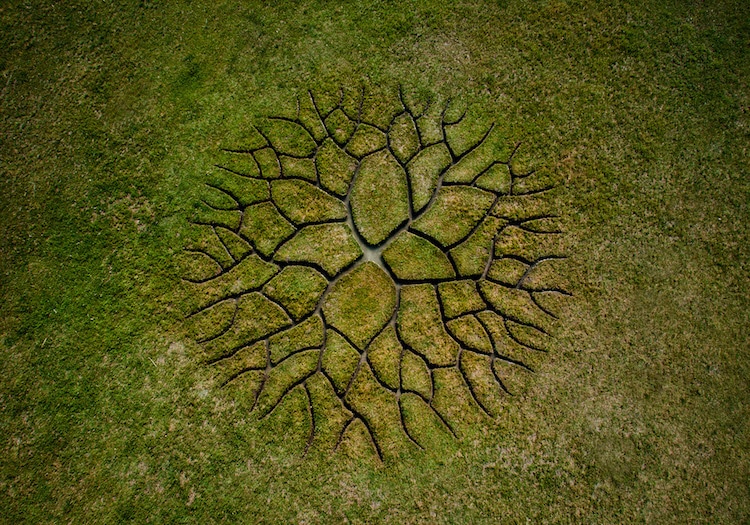
Change
“The only constant in life is change”—whether it was Greek philosopher Heraclitus that first said this or not, this cosmic law is omnipresent. For me, this has grown to become a comforting notion at best, and a bittersweet medicine otherwise. I suppose it really isn’t any use having strong sentiments on the matter, but then again, such a rationalisation has never stopped feelings from being felt. Although the seasons still change, our world is a fast-changing one, and learning to move and truly be with that change is perhaps the most important thing we can do. The following quote from an interview with artist duo Blanc Sceol about their deep listening practices is spot on:
“There is a freedom of not just throwing it all in, like “oh, we’re all doomed and this is going down”. Actually, there’s more for us, much more we can experience, much more we can do, much more we can understand. […] We just need an attempt. An attempt to grasp. Which is why we call it practice, I suppose. Because each time we’re just practising, just try to get a bit closer to something.”
And with any change comes not just newness, but also discomfort, and sometimes unexpected beauty. Anna Tsing’s story of The Mushroom At The End Of The World remains one of my favourite to explain the possibilities this brings. Protagonist of the story is the prized matsutake mushroom that only fruits at land disturbed by human activity. It is an example of life always continuing, and humans—despite having major impact on Earth—not existing in a vacuum. With our and other species’ survival becoming increasingly precarious, we need to accept the pace of change as well as the fact that we are not, and never were, in control. This is a quote from Tsing’s book:
“Precarity is the condition of being vulnerable to others. Unpredictable encounters transform us; we are not in control, even of ourselves. Unable to rely on a stable structure of community, we are thrown into shifting assemblages, which remake us as well as our others. We can’t rely on the status quo; everything is in flux, including our ability to survive. Thinking through precarity changes social analysis. A precarious world is a world without teleology. Indeterminacy, the unplanned nature of time, is frightening, but thinking through precarity makes it evident that indeterminacy also makes life possible.”
In combining mindfulness practice with nature connection, ecotherapy can help us anchor in the present moment and notice however the world expresses itself here and now. Besides death and destruction, signs of new life and transformation can be found anywhere, sometimes we just need to learn to look better. Disguised under many names, ecocentric practices are teaching me a new mode of existing—or ‘being’ if you will. Being with and being together. Being in and with myself. Being in nature, and being nature. Because nature is everywhere, and perhaps we were never separate.
Artist duo Blanc Sceol
More Chapters
-
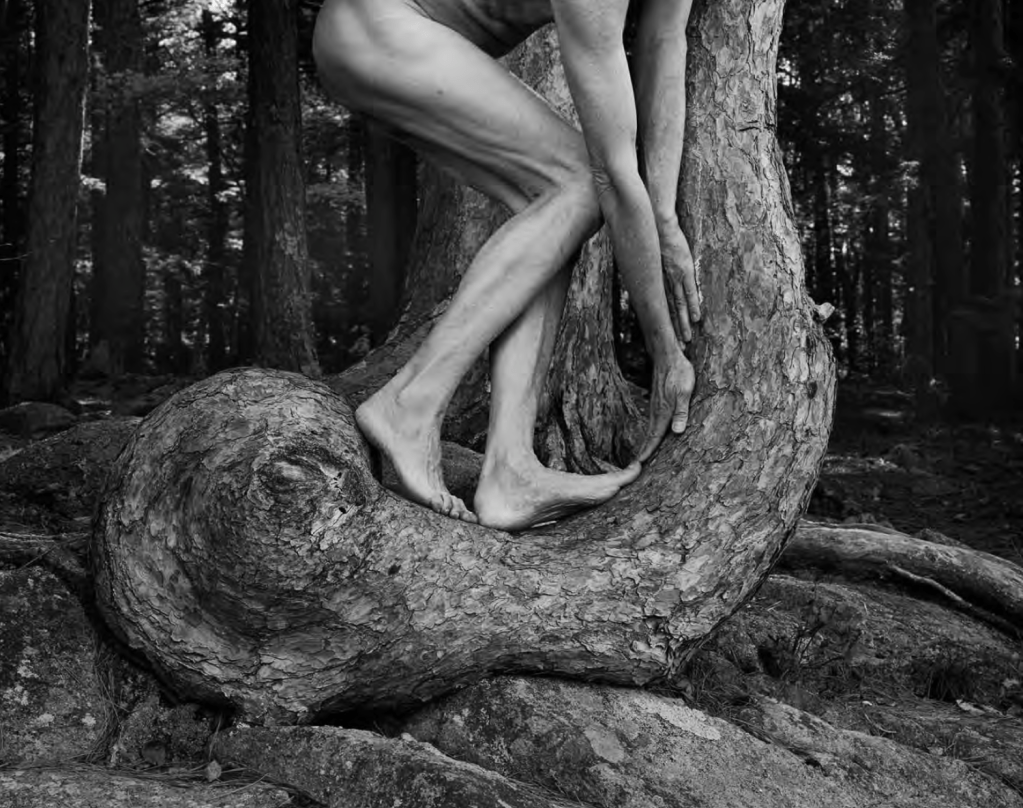
From Anthropocentrism to Ecocentrism
Here you can find the summary of (and link to) my published master thesis for Sustainable Development featuring the art of Arno Rafael Minkkinen. Summary This thesis researches main values… read more ꩜
-

Chapter 8: Earth, my home and body
This post means to wrap up a journey that started long before my studies in Sustainable Development; and one that will continue to become long after. It has been almost… read more ꩜
-
Chapter 7: Being with Change
“If you think of what we’re all going to encounter in the next ten, twenty years, in terms of environmental devastation, which we know is gonna happen, it’s very much… read more ꩜
-
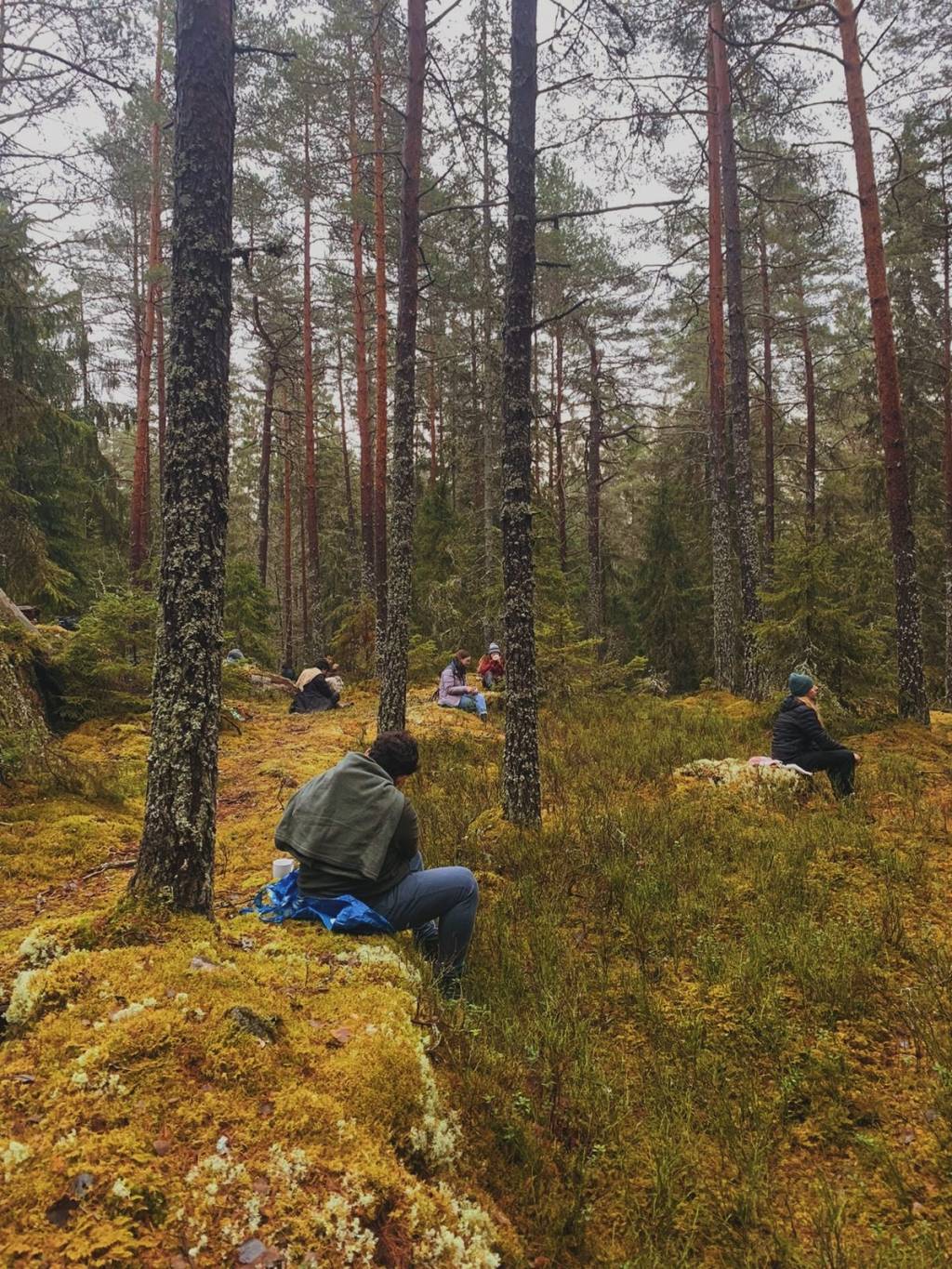
Chapter 6: Embodying our relation with Earth
How much do you feel part of Nature? How essential do you think your body and its senses are in connecting to your environment? This article shares practices and insights… read more ꩜
-
Chapter 5: Eco-Everything
As we see the prefix ‘eco’ being added onto more and more things, I wonder when this will become superfluous in a new ‘normal’. Placing oneself amongst likeminded people, let’s… read more ꩜
-
Chapter 4: Destinations
How do you navigate through the world, what is your vehicle, and who drives it? Whether you believe in linear or non-linear timelines, singular or multiple dimensions, there is a… read more ꩜

 Sacred Beans
Leave a comment