
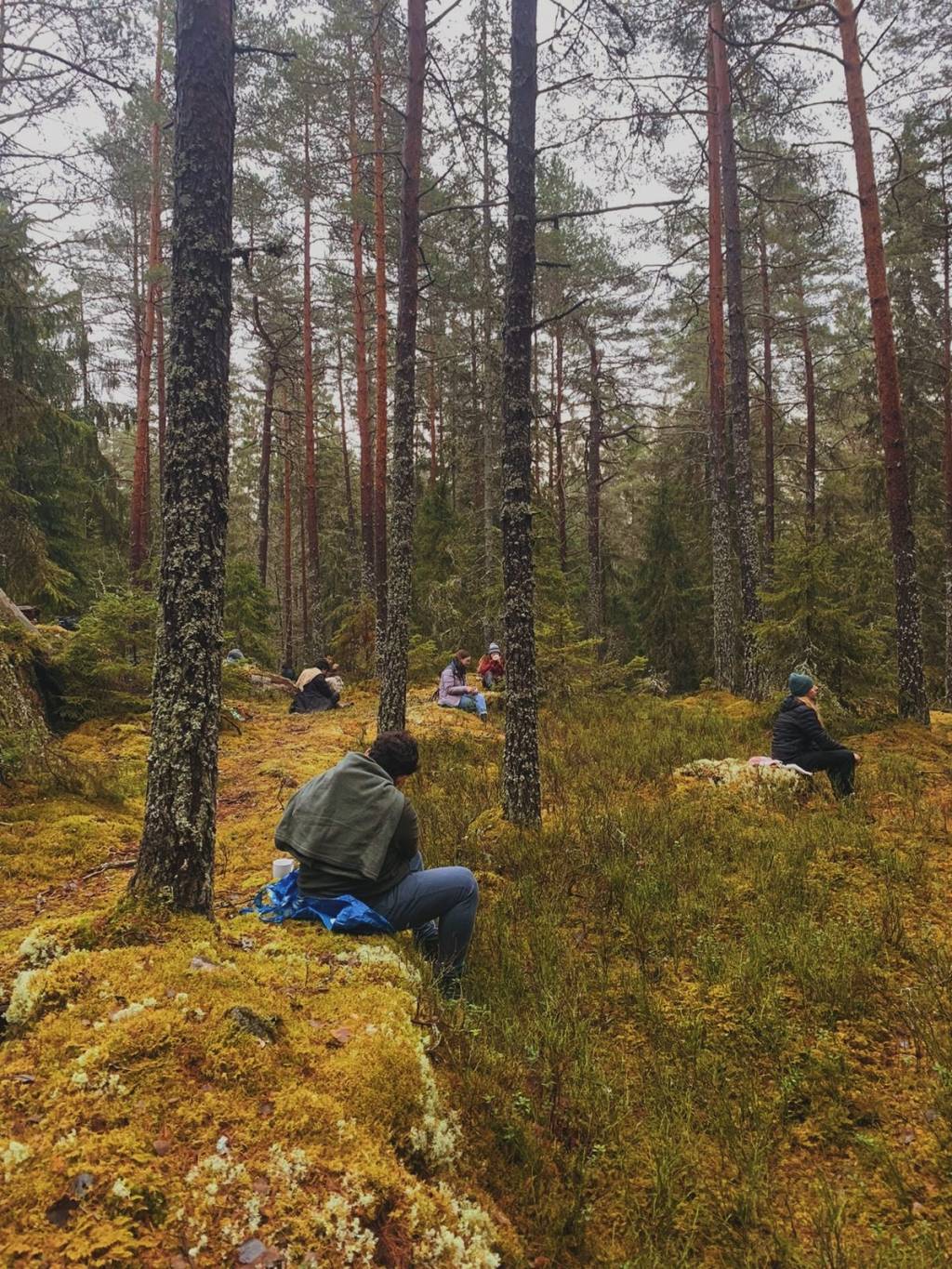
How much do you feel part of Nature? How essential do you think your body and its senses are in connecting to your environment? This article shares practices and insights from an ecocentrism workshop.
Before writing what I wish to write about, it is relevant to share that I am currently in my second year of the master in sustainable development at Uppsala University, from which I hope to graduate coming summer. Last year, and the first four chapters written on this blog, were part of me diving deeper into the roots of our human and planetary health crises, and finding solutions that I believe in. And I am slowly finding my own voice and truth. Ecocentrism plays a huge role in this, as do thinking and writing. So. Much. Writing!

A human-centred or anthropocentric worldview plays no small part in the unsustainability of our modern habits. Before learning about concepts like ‘worldview’ I never deeply questioned the beliefs we have as a society, let alone knowing what alternatives there are. An alternative that is still very niche but slowly sees a rise of subscribers and practitioners is ecocentrism. This is a worldview that sees us, humans, as part of Nature and larger ecosystems. Subsequently, this means that our societal systems and industries exist within an overarching ecosystem. To me this seems logical, but it is far from widely recognised as we still treat ‘natural resources’ that fuel our lives as if they are self-evident and infite, without much (if any) thought about ecosystems and communities harmed during cultivation and extraction processes — let alone future generations that will have to do without such resources and cope with an increasingly erratic climate.
So, what about ecocentrism? A nice concept in which hopefully many will find some truth, but how does one reach a deeper level of understanding and get beyond a superficial or intellectual knowing? The short answer is that to change our beliefs we need different experiences, different thought patterns, and different consumption patterns, including media we consume or narratives we subscribe to. We need to re-learn how to be fully present in our living environment, whether these are natural or urban. Despite the world ‘learn’ being present, this can be fun and is extremely rewarding! The rest of this post will elaborate on possible practices that may form a tangible base to grasp ecocentrism.
Connection and Ecosomatics
Where our anthropocentric, reason-driven world thrives on the isolation and clinical categorisation of parts, individuals and disciplines, an ecocentric world is based on interrelations, connection and complexity. Ecocentrism recognises humans to be part of a larger whole, and understands that we, and all our societal systems, can only be as healthy as our environment — and vice versa.
Movement artist and scholar Raffaele Rufo researches how somatic art and movement practices can help us “regain ecological futures by challenging the supremacy of mind over body and the dominance of humans over other species and living systems” (Rufo, 2022, p. 2). On that same page he also phrases the following:
“We are part of the earth, not separate from it. […] To change our worldview, we need to change the way we perceive the world. And to change our perceptions we need to change the way we think about the world. So where do we start? Critical embodied practices can offer us the gateways needed for experiencing the continuum between human-and-natural worlds by reinhabiting our bodies as ecologies nested within larger (and smaller) more-than-human ecologies.”
Somatic practices can help us connect with our surroundings and embody our relation and relatedness with the natural world. Intuitive movement is one of these, as is mindful breathing, or consciously engaging our senses to pick up on the (mainly) non-verbal and non-visible language of Nature and her beings.
Practising embodiment
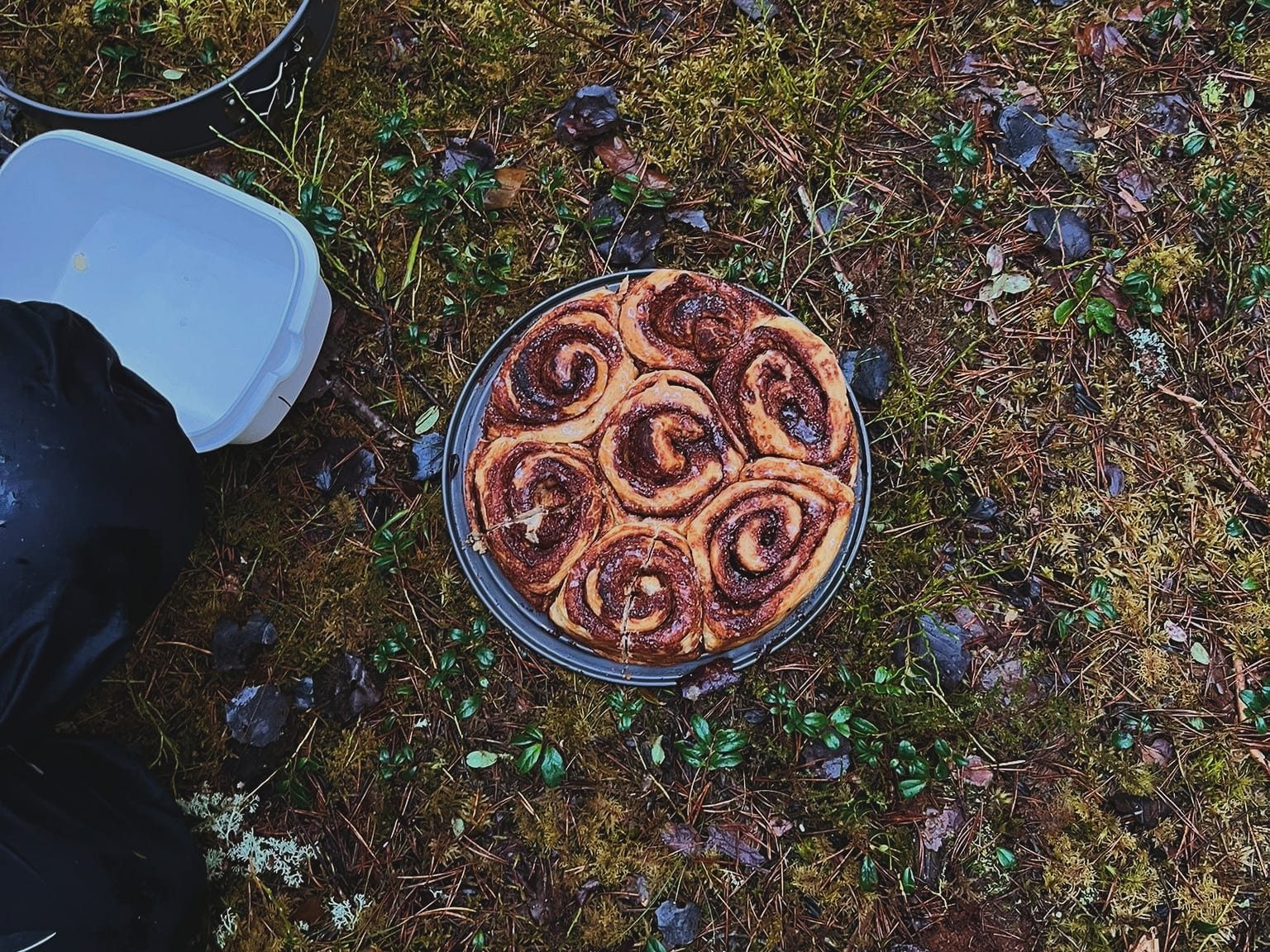
For a course this semester, me and three classmates hosted workshops that were meant to offer participants an introduction to ecocentrism. One of these workshops was focussed on the embodiment of the relation we harbour with our home planet. However small-scale this workshop was, participant reflections before and after the workshop offered evidence to how certain activities can help us tune into our bodies and the world around us. A lot of research was part of creating a format that compiled several practices that we deemed useful and, not unimportantly, fun to do in a forest in cold Sweden.
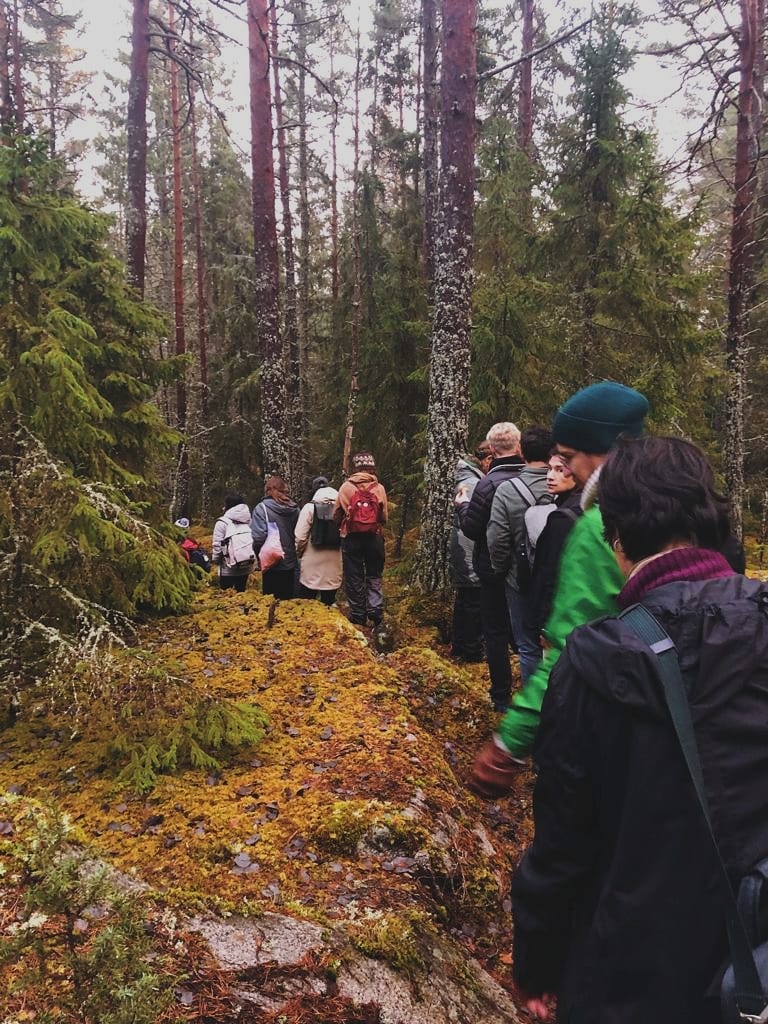
After assembling, we (sixteen students of varying backgrounds) had a fifteen-minute silent walk into the forest. For some this was uneasy at the start, especially for those who thought that ‘silent’ meant ‘anti-social’. We acknowledged passerbys with a smile or nod, but were otherwise not talking to one another which enabled us to quiet our over-active minds and tune into our surroundings.
Arriving at the forest spot, we had two activities planned: a playful one and a more meditative one. In-between we had some movement and mindful breathing exercises, to center in our bodies, stay present, and stay warm. For the playful exercise we aimed to lure people out of conventional thinking an relating to their environment, and asked for them to ‘walk in the skin’ of another animal or insect. We then had people search the environment for treasures, like something soft, something sharp, something beautiful, something delicious and something precious. This already sparked some conversation: do non-humans perceive things to be beautiful? If so, how? We concluded that a concept like ‘beautiful’ may be more than just esthetically and visually oriented.
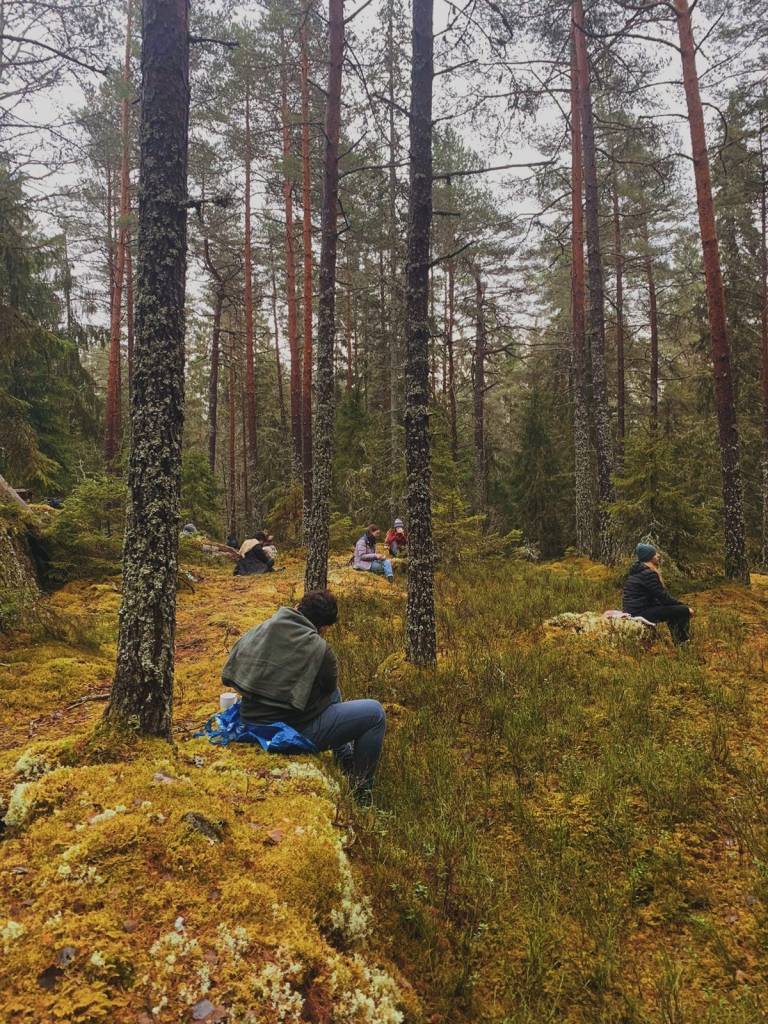
The second exercise was a sensory meditation. Every participant was invited to move around, and, with a cup of warm pine needle tea, find a spot to settle down into comfortable silence. We then guided people into their senses one by one — their sense of taste, touch, sound, smell and sight. We allowed a few minute of stillness to allow people to settle in. After this we introduced gentle guidance and questions to help people explore their respective senses and their environment even more.
Further exploration
The workshop was a valuable experience because of people’s insights and a general togetherness even when doing something meditative. It made me sure of wanting to continue down this overgrown and muddy track, and of wanting to work together in a team that has their noses pointed in the same direction.
Personally I have engaged in embodied and somatic practices for a while, and I only get more and more reason to keep at it. Apart from just pulling me out of my head, which always tries but not always succees to make sense of the world, it taught me a new way of sense-making, largely through using my senses (pun intended). Experiencing how much it can serve in connecting to others, whether human or non-human, is something that makes my heart overflow.
Further time, energy, blog-space, and even my thesis (!) will be dedicated to more of this. How far can I stretch the boundaries of the self? How much can I come to feel to be (in) my environment?
The world is calling to us — if only we all spoke the same language
Refence(s)
Rufo, Raffaele. “Somatic Arts and Liveable Futures: (Re-) Embodying Ecological Connections.” Part of the project ‘Natureculture Pedagogies’, 2022. DOI: 10.5281/zenodo.7629756
More Chapters
-

Chapter 3: The stories we tell
We take a look at how language and stories shape the way we relate to the world, starting from a young age and throughout our entire life. Narratives shape our… read more ꩜
-
Chapter 2: Fractured
In this post we dive into what it means to have a fragmented perception of ourselves and our surroundings, and trace the cracks to find out how deep these might… read more ꩜
-
Chapter 1: How on Earth did we get here?
An introduction to a new (or rather ancient) perspective on planetary health, and embarking on a joint journey of discovery. We find ourselves on a planet that has many secrets… read more ꩜

 Sacred Beans
Leave a comment