
An introduction to a new (or rather ancient) perspective on planetary health, and embarking on a joint journey of discovery.
We find ourselves on a planet that has many secrets still to be uncovered. Think of the depths of the oceans, how fungi communicate, or how the soil seems to store memories. And yet, with every discovery made, every finding placed on a graph, this place seems to become a little less magical. To make sense of the world, matters need simplifying. The danger in this is that we forget the beautiful complexity of the real world around us.
Roughly three years ago I got sucked into a big black hole that is learning about man-made climate change and destruction. I started uncovering layer after layer, trying to get to the root of the problem. Why are we in this crisis? When did we get so disconnected from nature? Why is change happening dreadfully slow? What can I do to help, and also, how do I stay sane? Self-education only takes you so far. It can have you spiral in the wrong direction or simply get you stuck. Both made me wish to be educated in a more secure environment. Last August I started a master programme in sustainable development, for which I moved to Sweden in my wonky home on wheels.
These chapters, of which I have planned nine in total, will be honest reflections on what I learn during this journey of discovery. What I really want is to take you with me down this road, into reimagined futures. For this, we need the same starting position. And that is exactly what this post is meant to be. So let’s rewind!
Rewind
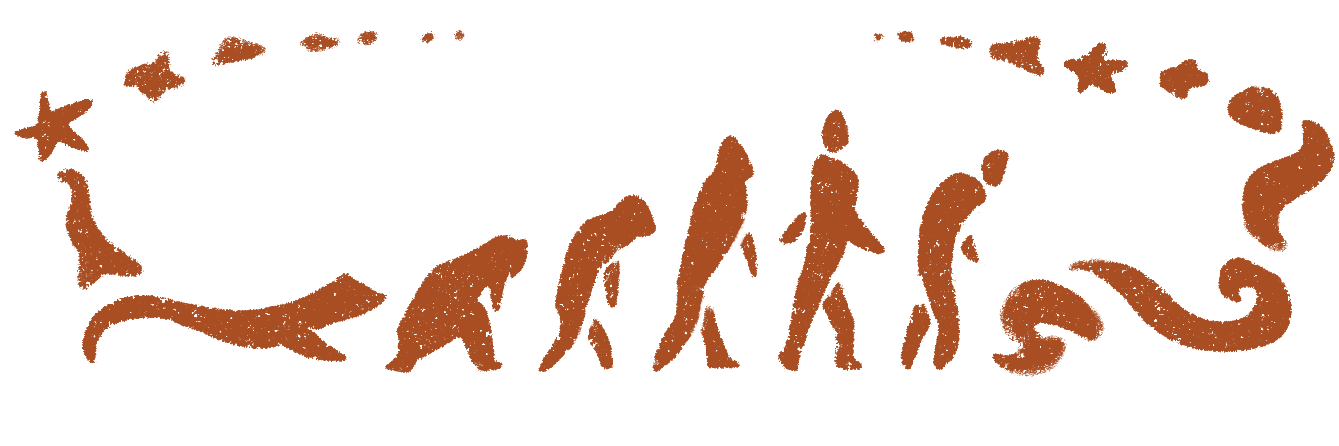
We, Homo sapiens, possess an incredible ability to cooperate and make use of our creative imagination to work towards a shared goal. Which is what we have done since we walked the earth alongside our ancestral siblings. Closing off an era of ice ages about 11,000 years ago, Earth’s climate got relatively stable during what scientists call the Holocene. Since then our agricultural practices have skyrocketed, as have our numbers.
We now live in what is popularly called the Anthropocene, the Era of Men. When exactly we entered this era is a topic for discussion. The name indicates a time where human influences have significant, even irreversible, impact on the planet’s climate and ecosystems. A milestone has been discovering the potential of fossil fuels leading us into a power surge and making us feel unstoppable. Gaining access to such a dense mass of stored energy has enabled us to overcome many natural limitations. Hours of labour were replaced by this finite fuel we burn so cheaply.
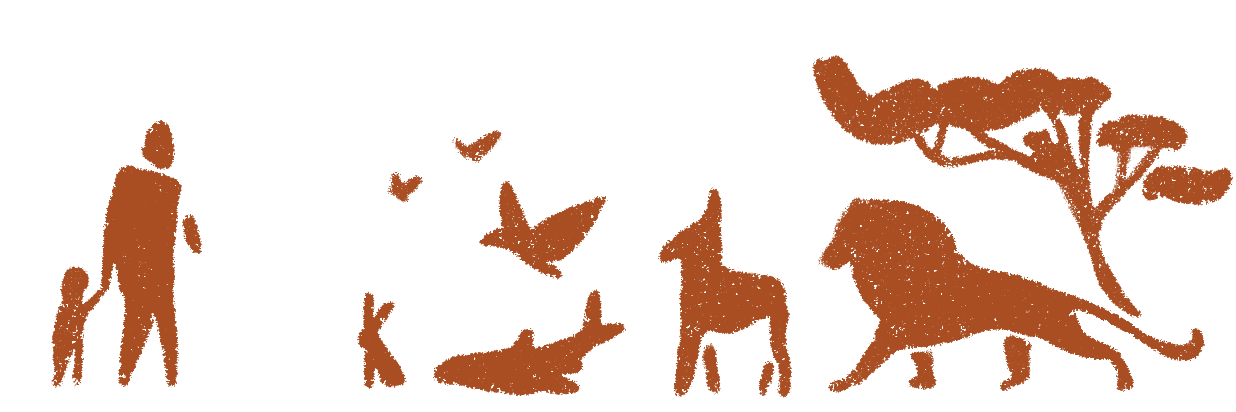
Along the way, some of us have lost touch with what really matters, and now confuse the Western standard of living with quality of life. Modern man has become skilful in turning common resources, Earth’s gifts, into commodities to sell. Besides just separating ourselves from non-human life, we are estranged from fellow humankind as well. This enables us to colonise, murder and exploit to ensure our wealth. Growing up in thriving, developed nations in the Northern hemisphere, we aren’t taught to question the cost or origins of what is placed at our feet.
Man versus Nature
Western science has become a dictator in how we experience ourselves and our surroundings. Phenomena are studied as separate from the environment they exist in; interconnections and relations are replaced by boundaries and polar opposites. Our dominant philosophy is rationalism, on which we base most of our systems and intellectual beliefs. Reason is our wielded sword and logic our shield. Emotions and intuition come secondary when perceiving matters, for they are subjective, even deceiving! And so we forget that our living, human experience on Earth is wholly subjective: perceived and felt individually.
This fractured worldview is a relatively recent one, say a few centuries young. There are some who describe this to be the root of many of our crises. Think injustice, ecocide, over extraction, the current energy crisis, and mental health concerns being more norm than exception – to name a few. Once, we believed that mind, body and spirit existed within the same realm. Before Reason became our God and Guru, we too applied a more holistic perspective, as is common in ancient cultures.
The word ‘holism’ comes from the Greek word ‘holos‘, meaning all, entire, total. Holistic philosophy explains that the properties of any system cannot be determined or explained by its parts alone, as the system as a whole influences how these individual parts rank and behave. The term was created by Jan Smuts in his book Holism and Evolution (1926), where he defined it as “the tendency in nature to form wholes that are greater than the sum of the parts through creative evolution”. Aristotle already introduced the principle of what was to become holism in his book Metaphysics (350 BCE) as “the whole is more than the sum of its parts”. Perhaps this knowledge is as old as life itself.
Ecopsychology
One of my classes teaches about ecopsychology, combining (holistic) ecological theories with psychological ones. I was introduced to perspectives on climate change that examine how we have come to place ourselves in the world: superior to nature; estranged and disconnected. This is not to say we all consciously chose this way of living. On the contrary, this worldview has gradually been worked into the cement that binds the bricks of our society. If you have been born in a Western country like myself, this perspective has likely been spoon-fed to you and several generations before you. Is there a chance our beliefs are outdated? Are we in need of something else, to pierce through the shallow veil, and find something deeper and richer?
Parallel to learning about the restoration of our ecosystems is my personal healing and learning process. There are times when I feel how closely these two are intertwined. In Where Psyche Meets Gaia (1995), Theodore Roszak writes the following on restoring Earth and healing the mind:
“We are living in a time when both the Earth and the human species seem to be crying out for a radical readjustment in the scale of our political thought. Is it possible that in this sense the personal and the planetary are pointing the way toward some new basis for sustainable economic and emotional life, a society of good environmental citizenship that can ally the intimately emotional and the vastly biospheric?”
To me, this underlines the urgent need to recognise ourselves as the complex, multi-faceted beings that we are. And in doing that, we will find our natural world to be similarly complex, intelligent, resilient, and wildly beautiful. Such a re-enchantment with the planet housing and feeding us may just inspire to restore her. As well as revive the parts of ourselves that have been tamed, or killed, because stories of never ending progress allow no space for them. So, we will create space. And new stories, too.
Where do we go from here?
Having drawn a connection between our planet’s well-being and our own, this is where I want to leave this post. We have much to learn, but all we can do is try for a best possible future. The fact that so many souls share this sentiment gives me hope, a sense of belonging and connection in itself. I am looking forward to this joint journey of ours: to explore non-ordinary realms, together.
Some academic essays may be uploaded on this platform. My studies have me researching interesting topics! For other posts I will explore future scenarios, question popular beliefs, dive into other worlds and ways of being, and write about reconnecting with both our internal and external realm. Let’s introduce love, magic and kindness back into a world that often appears harsh and uncaring.
With warmth,
Nina
Cover image artwork by Peter Mohrbacher
More Chapters
-
Chapter 3: The stories we tell
We take a look at how language and stories shape the way we relate to the world, starting from a young age and throughout our entire life. Narratives shape our… read more ꩜
-
Chapter 2: Fractured
In this post we dive into what it means to have a fragmented perception of ourselves and our surroundings, and trace the cracks to find out how deep these might… read more ꩜
-
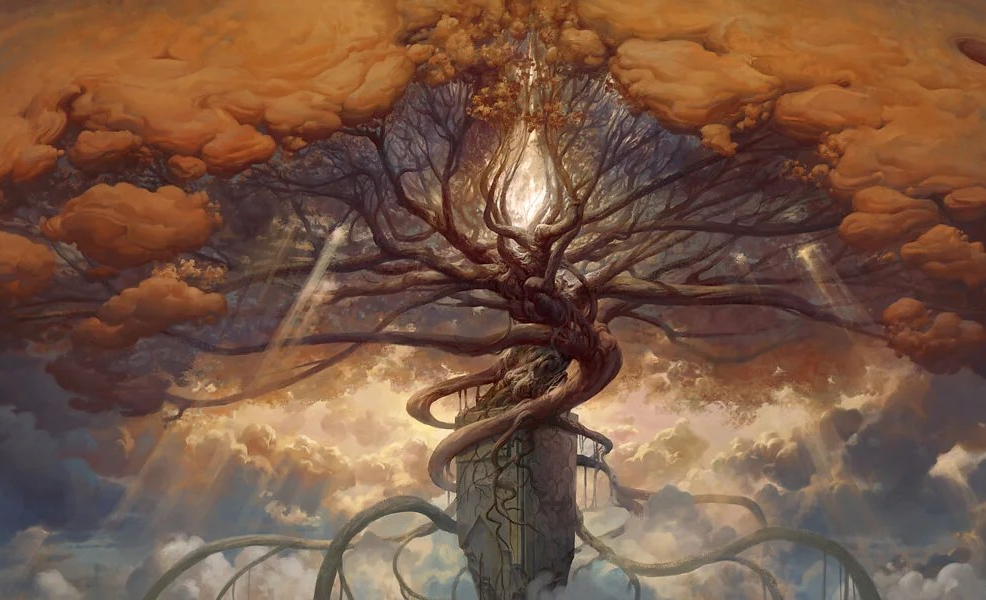
Chapter 1: How on Earth did we get here?
An introduction to a new (or rather ancient) perspective on planetary health, and embarking on a joint journey of discovery. We find ourselves on a planet that has many secrets… read more ꩜

 Sacred Beans
Leave a comment