
What does ecopsychology mean to me? Can I accept that all my sides, even my messy and prickly ones, are part of my whole? How do I grow compassion when I find myself stuck in egocentric living and thinking?
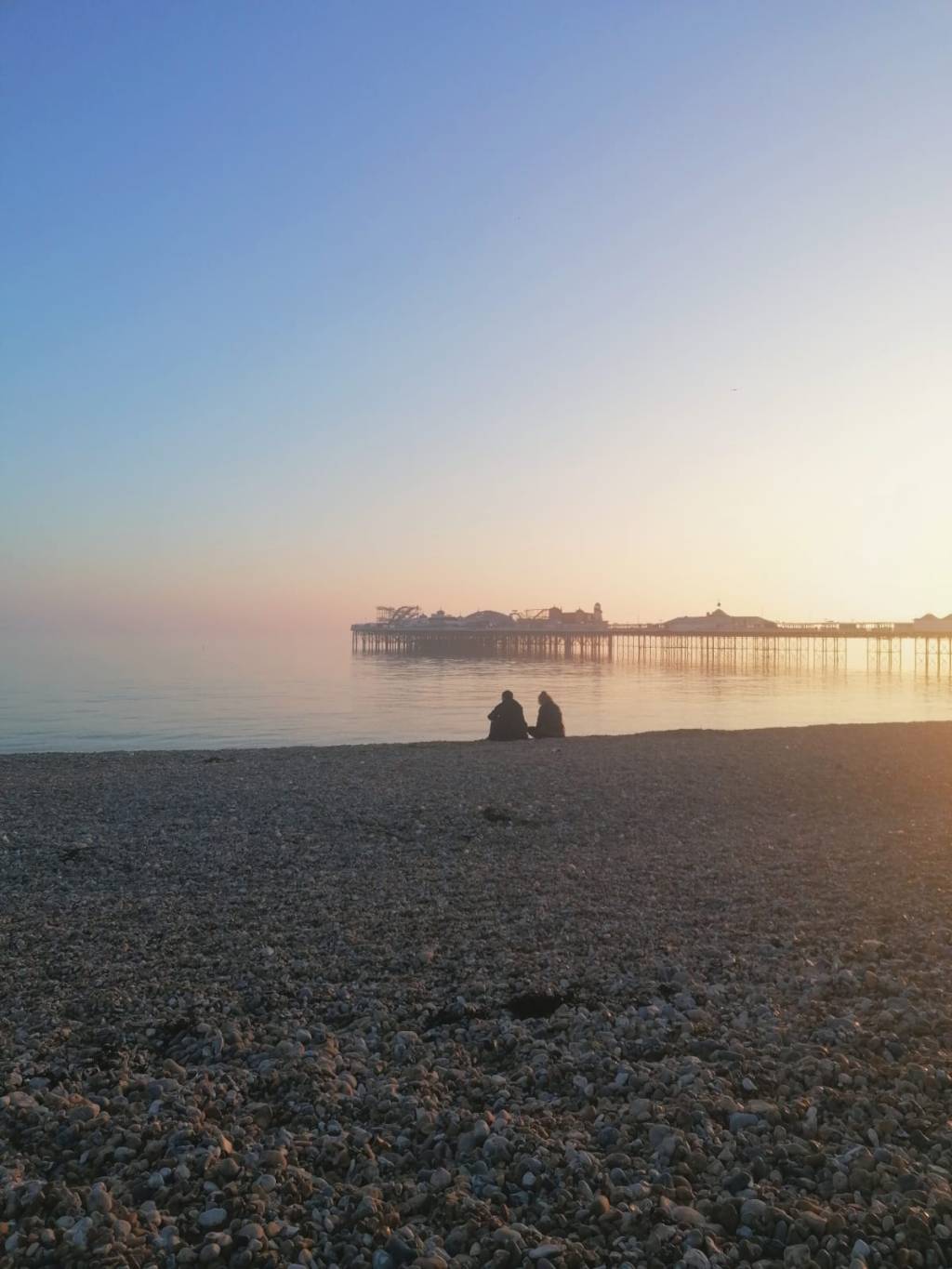
A heap of questions has always been my best guarantee to finding answers. Looking back to the questions I asked a year ago, after recently having relocated from Sweden to Brighton, I got everything I asked for, and more. The text below is from a piece of writing I did on Brighton, which at the time felt very identity-obsessed. (It still does.)
“Can you help me find creativity? A story to write? Someone to love? And if not, can you offer me a story to get absorbed into? An identity I can adopt? History I can borrow? A cheap surface finish to hide behind, as I continue my search for something more fulfilling, more lasting, more my Own?”
In the meantime I have initiated a relationship journey with one of my dearest friends, and therefore, in a way, with a new self. Trying to move with this new love inevitably opened up old wounds, and re-emerged behavioral patterns that clash with what I normally consider to be very strong and independent foundations of my self. Building a new existence in Brighton has been very human-centered, while gradually my spiritual and nature-centered practices fell away. I became obsessed with conforming to a version of myself I wanted to be, and carried relationship expectations that largely came from my time being a single individual. In not being able to live up to these perfectionistic visions, I at times caused chaos and even hurt. This old stuff clearly didn’t work anymore. Who was I to be, then?
The seeds I randomly (desparately) scattered to try and start co-creative projects or new habits never took root. Navigating obstacles while learning to speak a common love language with my partner became a new focus. And then, in distancing myself from noise and fear, I am re-finding that solid foundation of my own unique experience in this life. This essence has always been there, waiting for me to fall back in love with it. Or, at the very least, to become curious of the ways this essence interacts with the world. And with this little nugget of hope I left for my first weekend as a student on the course in ecopsychology. I felt messy. I felt vulnerable. I didn’t feel particularly ready. But I was soon reminded how much I love being a student.
Development or breakdown?
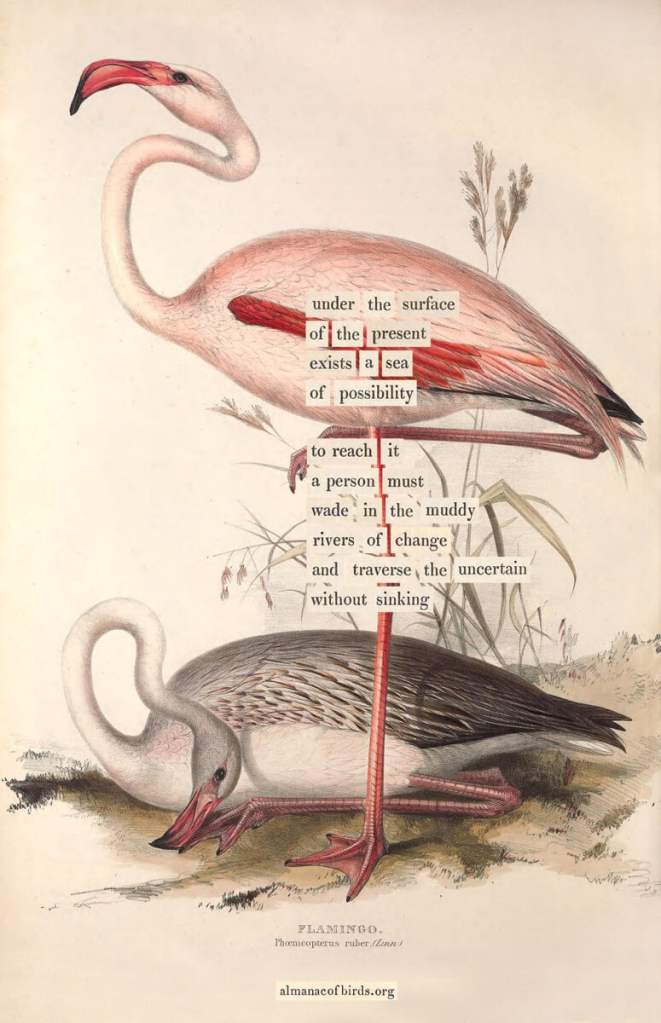
Let’s shift our focus to something bigger and more external. We are amidst times of rapid transformation, turbulence and development that are pulling us in all directions. AI and technology are leaping ahead, calls for social justice are growing louder even as crises seem to grow more heartbreaking, the internet connects us to people and narratives everywhere on the globe yet freedom of speech is still under threat, or considered a threat, and seemingly holistic or ecologically-oriented initiatives are popping up while many of our futures are still being built upon the reliance of ancient systems and the burning of fossil fuels. These contradictions show our dualistic reactivity and a new paradigm emerging. If we are to be ahead of change and transform our systems for the better, we are to be wary of this reactivity.
Emerging, also, is the re-integration of the ‘natural world’ in all things human. Great thinkers and investigators of the human psyche, like Sigmund Freud, have stated that our ‘ego-feeling’ is closely entangled with the world about us. For most modern humans, this ‘outside world’ has become increasingly urbanised and steered by technological developments. This comes at the cost of a felt and practiced connection to nature. While not everyone may feel like they need this connection, and are quite content in a world so separate from all things wild and unpredictable, there are life philosophies that build upon our ancestral ties to the more fluctuating and cyclical realms in which we used to exist. These are complex realms that offer a lot of nuance, yet that aren’t as easily dissected and put into separate boxes as our modern systems like to do. The illusion that we are somehow in charge is kept in place, even admist natural disasters, shocking events, and unstable futures.
Eco | psyche | -logy
When trying to re-entagle the very complex personal and inter-personal landscapes of existence, ecopsychology makes a good attempt. In the 1995 book Ecopsychology: Restoring the Earth, Healing the Mind, Theodore Roszak explained ecopsychology as an interdisciplinary field that entwines human psychology and the environment. This is to restore the connection between us humans and our home planet, and in that healing the alienation between the urban human psyche and the natural world. Roszak coins the theory that this disconnection is at the root of many (mental) health issues, and that in restoring this connection we can heal both people and the planet. In that same book, Robert Greenway wrote the following:
“Ecopsychology is a search for language to describe the human-nature relationship. It is a tool for better understanding the relationship, for diagnosing what is wrong with that relationship, and for suggesting paths to healing.”
The above exerpt forms a bridge to my own understanding and definition of ecopsychology. To form a base that helped me define my understanding, dissecting this word let me look at the various meanings that together build a complex field of study—and practice!
Eco
Stemming from the greek ‘oikos‘, meaning ‘home’ or ‘dwelling place’, the word eco refers to our external environments. They change as we move around, by other beings coming and going, and they shift by being in flux themselves (the weather, seasons, landscaping, natural disaster). Static home structures can be our houses, or other geographical locations where we spend a lot of our time. More dynamic, and perhaps more abstract, I consider our dwelling places to also include our social circles. In most ecopsychology and ecotherapy settings, a natural outdoor setting will be chosen, to benefit from its soothing effects, and also to foster and build on the human-nature connection.
Psyche
This is the core self, or what I simply understood as ‘me’. The word psyche comes from the Ancient Greek word ‘ψυχή’ (psykhḗ), meaning ‘breath’ or ‘life’, and later ‘mind’ or ‘spirit’. The ambiguity of this meaning rings true to me. Our internal landscape is constantly in flux and difficult to define. Depending on what we consume, and I don’t only mean food, we affect our internal processes. Bodies with wombs ovulate and menstruate—a very clear cyclicality, like the sun and moon phases. We aren’t only our mind (and even our mental body is a complex landscape with many voices that introduce meaning into our lives on both conscious and subconsious levels), we are also our emotions and our experiences.
-logy
This suffix is pasted at the end of words to mean ‘the study of’. In the contect of ecopsychology, and with the help of other ecological thinkers, I came to the understanding that the studying of the relationship between our dwelling places and our selves—eco and psyche—is the constant conversation between our external and internal landscapes, as well as the search for a common language. This is where the body plays a huge role, serving as a vessel for our psyche, and a channel or tool for us to interact with the outside world. Embodied thinking, other ways of knowing, and somatic, sensory, felt and practiced experiences are all part of becoming more ecocentric.
During the course weekend we tried to define ecopsychology in a group setting. Naturally, meanings and understandings varied greatly, even with only twelve people. One topic of discussion was consciousness. Some consider consciousness to be a static phenomenon, potentially contained by a physical vessel. This was used to describe the communication between our own consciousness, or psyche, and the Earth’s consciousness or psyche. Perhaps complimentary to this, I strongly feel for the potential ‘creation of consciousness’ that happens through the communication of entities, and all symbiotic and synchronistic flows that arise from that. In ecopsychology, I would explain an effect of nature-connection practices to be creating a new awareness, or conscioussness: a planetary one! My consciousness is a co-creation between the life forces of my parents, the natural world, and the cosmos. This explanation would also make possible the destruction of consciousness.
Healing from egocentrism
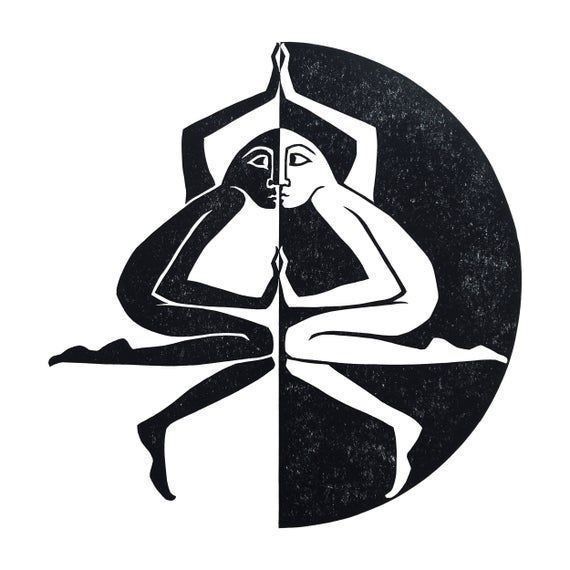
In my struggle to reshape my identity, and finding new narratives to fit new circumstances, I got more and more entagled in egocentric thinking and living. When thinking of terms like ‘egocentric’ or ‘narcissism’ we commonly associate these with dominating, loud and possibly even proud behaviours. The sneakier kind is the self-obsessed perspective in which an individual perceives anything that happens around them as happening to them. And although we are all the centre of our own universe, this creates very dualistic notions of ‘good’ and ‘bad’ things or people to happen to us, and also has the potential to remove a sense of agency, or responsibility, for our own lives, experiences and emotions.
As mentioned above, a symptom of egocentric living (which I also think a very common symptom of our modern, disconnected, highly urban lives) is extremely dualistic thinking. At the essence of our lives, or consciousness, many cultures and life philosophies recognise two contrasting or counter-balancing energies: the forces of yin and yang, creation and destruction, or the feminine and masculine. And although I believe that the interplay between counterforces shapes and creates life as we know it, and while they make beautiful ceremonies and rituals, it should also be clear that in our physical and non-physical realities life manifests as complex nuances and expressions of these forces. Most of the natural world displays an interplay of opposite energies that are constantly in flux, and that do not exist in strictly binary notions.
As I tried to turn away from my own binary stories—in which I either make all the right or all the wrong decisions, and am either my best or worst self—life started to open up again. I started to open up again. Experiencing connection with people, beings, and landscapes outside of myself got me out of an egocentric perspective, and helped me move towards the ecocentric thinking I so believe in (and have previously lived). Having noticed this shift helped me find gratitude for seemingly ‘losing’ myself in other peope’s narratives and realities. This is a cycle I expect to return to at many points during my life, as it’s only natural. We are social beings that are inherently dependent on connection. We constantly move through roles in our own stories, through other people’s stories, only to find that we over-identify with them, or outgrow them, or are hurt by them—which is when we need to step away from ourselves to expand our perspective. And nature is a great teacher, true friend and wise guide in doing so.
An essential ingredient in healing from ‘egocentrism’ is, besides connection, a compassionate attitude. Without also growing or nurturing compassion towards yourself and others, the journey towards ecocentric and connected living will be a harsh one without much meaning. If we are to truly think holistically, we can see the parts of ourselves that have caused hurt as being the guides and teachers they can be. We can accept them as being an integral part to our being, while not over-identifying with them, or adopting their main narrative through which to live our lives. I’m conscious of sounding preachy, especially as this is something I struggle with myself. But the experiences that are most healing to me tend to happen in settings where authenticity is valued and compassion is offered. I’m hesistant of using the word ‘safe’, as it doesn’t always feel safe to express any complex, heavy thoughts or feelings that we carry around. But there certainly is a level of safety experienced when people express their needs and boundaries clearly. It helps me do the same.
So, all in all, arriving as my messy self in this first weekend on my course helped me find compassion. Entangling my very personal experiences with a shared experience in a natural setting helped me find compassion. Talking, listening, and holding space for others helped me find compassion. Letting myself be quick to shed tears and not hide from them helped me find compassion. Feeling seen and heard in my needs helped me find compassion. Seeing nature exist without the story and express itself in so many changeable ways helped me find compassion. And this is the connection—with parts of myself, with others, with nature—that heals from isolating and alienating egocentrism.
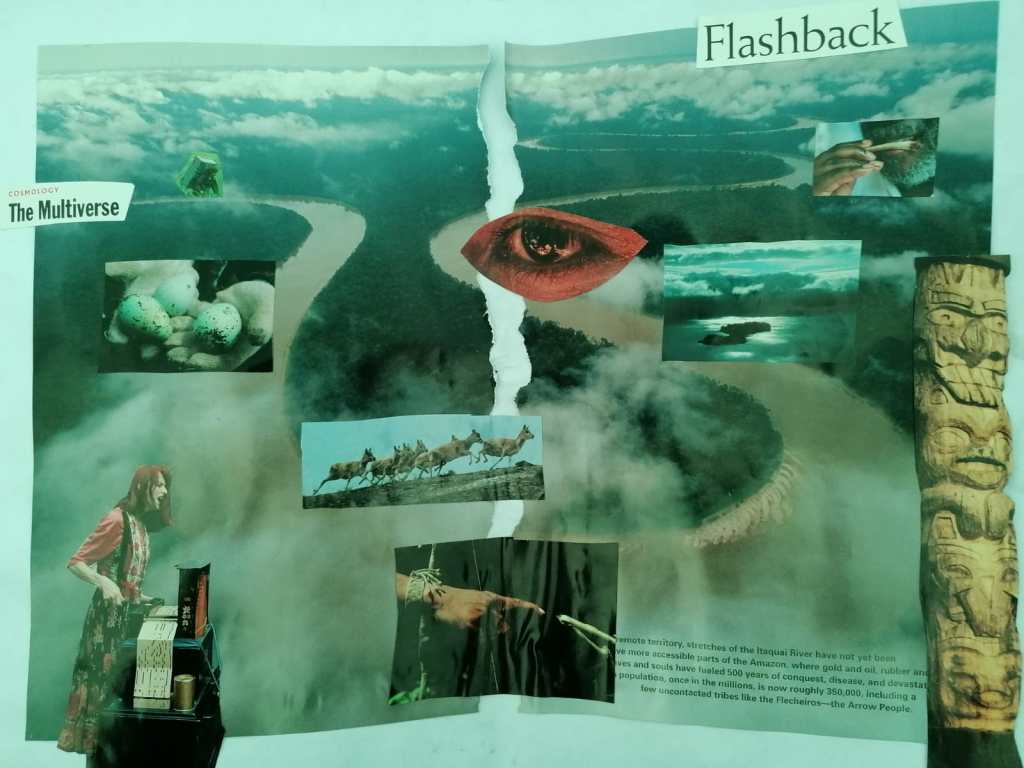
Mapping my journey
Wrapping up this post, I wanted to share this collage as a way of forming a bridge to future posts. As this weekend was only the start of a journey, an attempt to ‘predict’ this journey feels silly. But, having already moved through similar cycles, I mapped out the following loose phases of a reconnection journey:
- the eggs, re-birth, and start of a new arc;
- the herd, finding your crowd or tribe, audience, peers, however big or small, and finding your role or place amidst these
- the performance of ego, conformity, external narratives, when the balance tips and becomes egocentric, symtoms are getting stuck, something failing, becoming fearful, self-pity, self-doubt, your mask or role becoming your full identity (over-identification), hitting a ceiling or wall, finding yourself in environments that don’t reflect who you are, losing confidence (insecurity)
- reconnecting, healing from your separation story, intending to (or recognising the importance of) move from egocentrism to ecocentrism, intention or desire to shed old skins, wanting to take a break or distance yourself from roles or masks
- finding your foundation, creating your pillars of truth amidst change and instability, filling your toolbox, engaging in embodies and sensory practices, grounding, all of which are essential when aiming to shed your ego and not lose yourself
- becoming an island, period of isolation, water is relevant for moving through emotions and energies that need clearing, washing, preparing your vessel for a new arc, opening yourself up, mapping out intentions, where more abstract intentions will help you stay open and attract what is ready for you instead of dictating results
- seeing through your third or inner eye, mapping your internal landscape, bearing witness to all that you are shedding and all that is dying, honouring the fertile landscape this creates for new growth, noticing, sensing, receiving messages, opening up and remaining open, taking everything in but abstaining from in-depth analysis and reflection at this point
- sucking the marrow out of the bones of life, celebrating your process, starting a new diet, being mindful with all that you consume, nurturing and tending to your essential needs, more symbolically this is ‘feasting on your old bones’, centering on gratitude, refinding joy, staying humble
- flashback: do it all again!
Thank you to those who are with me
in any shape or form.
⋆ ⁺‧₊˚ ཐིཋྀ ˚₊‧⁺ ⋆

 Sacred Beans
Leave a comment