
How do you navigate through the world, what is your vehicle, and who drives it?
Whether you believe in linear or non-linear timelines, singular or multiple dimensions, there is a destination that holds power over every human being: the Future. The future could be described as any moment after the present. It is powerful to the extent that what in essence is a not-yet-existing moment can take our conscious mind out of the present, as we are often either dreading, dreaming about, or trying to control the future.
In order to plunge into this topic, I would like to point out that although ‘the future’ is used in a very determined sounding singular tense, an infinite amount of futures could be imagined and come into existence — depending on your worldview. My own belief has shifted from thinking there is but a singular and linear path in life for every being, to a complex webbed type of possibilities. Causation has a place in both. Imagination, and a sense of agency, come with the latter. As far as I know there is no scientific and measurable evidence for either of these to be ‘right’ or ‘wrong’, so whichever you believe to be true comes down entirely to just that: belief.
This is an existential topic that fixates and occasionally frustrates humans. If there is but one destined way forward for each of us, then me shifting my own perspective (and possibly yours) is apparently part of that. The reason why this is important when discussing topics like climate change, sustainable (or any kind of) development and possible solutions, is that some beliefs inspire action rather than inaction. Similarly, some beliefs inspire us to strive for the best possible outcome whereas others entice us to take a backseat and let anything play out on autopilot. If we believe there is a future (or even a present!) in which we have full agency of our lives, we may be more likely to consider the values that inspire our actions and describe meaning to them. After this long and philosophical introduction I mean to examine the destinations – the futures – that are likely to come with various worldviews.
Choosing a destination
You may have heard of the term ‘business as usual’ when it comes to progressing or developing a certain way. I will compare this to a vehicle moving on autopilot, where it moves forward following the road of least resistance, trying to sustain settings like speed and direction it has previously been set to. Entities make progress or move forward on autopilot when they are not making conscious decisions. Not making conscious decisions, or moving on autopilot, may be caused by a few or more reasons:
- The entity has handed their power to decide to another entity, which could be out of trust in the other’s ability to choose, or be caused by a belief they themselves are unable to do so;
- This power has been taken from them;
- They are scared of making changes;
- They don’t see any other way of doing things;
- They are unaware of there being choices and decisions to be made, therefore being unable to make conscious decisions.
Many of the possible causes for trudging (or thundering) forward on autopilot are relevant within society’s systems. Subjects like sustainability and climate change intimidate most people and are therefore often left to discuss for ‘the experts’. When things become political, and they often are, there exists a lot of taboo, judgement and ‘otherness’ to efficiently smother any conversation. Understandable, but a shame nonetheless, as these topics concern everyone and should very much be brought to the people.
Opposed to moving on autopilot is the manual operation of a vehicle. Manual operation takes active engagement from the driver (and a driver in the first place!) but allows for abrupt changes in speed and direction. Judging by the amount of information, warnings, and the growing amount of stories of disaster creeping closer to our homes, a drastic change of direction is required to minimise suffering and be better able to cope with fast-changing circumstances. A few ingredients are essential to allow for optimal manual operation, or conscious decision making, to be beneficial to anyone travelling in the vehicle:
- The vehicle needs a driver, or more than one to allow for rest and motivate clear vision;
- The driver needs to be aware of their responsibility for themselves and potential passengers;
- The driver and its passengers should all be aware of the decision making process. Whether this process is democratic or not, all entities within the vehicle should be aware of, and (ideally) agree with, the way of governing;
- There needs to be a decided destination, or vision, to move towards.
During fast changing times of chaos it is easy to become overwhelmed and even paralysed with fear. A common reaction is to give away all power. What I believe is that we need more people stepping into their power — in however large or small an area. The thing with transitions is that as old systems start to crack and crumble, spaces appear for new systems to arise. And to make changes for the better, we need systems rooted from values that align with the people and changing times. To return to my previous analogy: we need competent drivers to bring us safely to our next destination. And, ideally, the more the better!
Do we want to let others dictate our futures? To an extent, perhaps, if they are trustworthy. If we continue on autopilot, one leader can fall and a next one cut from the same wood will take their place. We need people with different knowledge, values, expertise and dreams to actually change direction. Nothing changes if nothing changes. Although, in a changing world change will happen inevitably, but these changes are also able to drag us along in a muddy river to dump us onto the next polluted shore.
Who knows what’s best?
Opinions are likely to vary. And that is exactly why we should aim for a Multiverse, where many different people can exist and live in different communities with different climates and therefore different solutions to problems like climate change. Most of our current world leaders have little to no knowledge about societal transitions and how to live in ways that truly sustain ourselves and our planet. But there are many people who have been learning and teaching other ways for centuries, and especially during the last few decades the focus has been shifting towards knowledge that will benefit us and generations to come.
Life is a patchwork of encounters and events. At times we may feel like we are in charge of our lives, only to later notice that the ground has shifted below our feet and we are faced with something we could never have foreseen. Nature exists in systems unfolding into larger systems, and so do we. This is the reason that many radical environmentalists believe we need to decentralise everything from energy, food and governing systems. With the power to decide being far removed from where we actually live, things only change in reactionary fashion rather than being truly transformational, and solutions are less likely to actually benefit the majority of people affected. Going with manual vehicle operation to drive us into the future we need more tailor-made solutions, smaller areas of governing, more direct democracy — and trust.
Choosing your vehicle
Returning to the analogy of moving on autopilot or manual operating a vehicle, I have yet to mention the most important factor in this story: the choice of vehicle. Travelling and navigating a landscape of chaos comes with a risk of leading you astray. To best explain this analogy I will compare two very contrasting vehicles: Hope and Despair.
With despair (paired with doubt) being the driving force behind your choices, you automatically aim for a worst case scenario. You may believe that this is the most failsafe option as it is good to have safety nets below risky endeavours, but at the same time the focus being on ‘bad’ will pull you into this direction. When you are to navigate a bend to change direction, your driving instructor will tell you to look into the direction you are aiming for. Besides that, you may fall back into (at its best) reactionary decision making. Trying to work out possible ‘unforeseen’ events and account for everything that could go bad will have you put out fires as they pop up. It is easy to forget to move forward at all.
Your vehicle being hope (paired with trust) will have you aim for the best possible scenario. This does not have to mean you get there, but it will steer you away from dead ends. Focussing on ‘good’ can be fuel on its own and create momentum. It can take a heavy load off your shoulders and motivate you to distribute whatever burden is left. Instead of reactionary decision making, this allows you to look further ahead, past the fires, and make more radical transformation happen as you ride the waves with good faith.
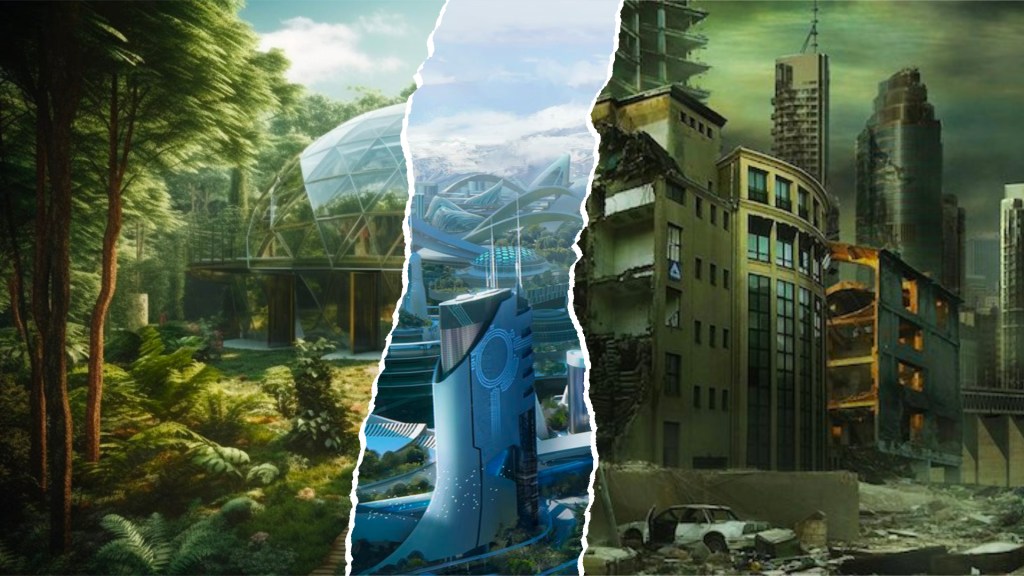
Having finished these analogies I would like to state that I will never vouch for any driver’s vehicle to be only hope. This can properly blindside you and cause any kind of emotional, intellectual or spiritual bypassing. There are both light and dark forces moving through our world. Good leaders will be able to see both at play and make well-weighed decisions in any situation. Yet another reason to have more localised governing systems and distributing leadership over multiple people, as we are all born with different qualities and a more innate sensitivity to either light or dark forces. Whatever our destination will come to be, it is important to be aware of our world containing elements of both Utopias and Dystopias. It is just a matter of choosing what elements will serve us best.
Our common future
Unless you breathe your last breath this exact moment, we all have in common that we have a future — however far or near removed from our present. What we do not by default have in common is how this future is shaped. Our transformational times come with increasing stories and imaginaries of Utopian and Dystopian worlds. I think of The Last of Us and Sweet Tooth both portraying post-apocalyptic worlds where a virus has heavily decreased our world population. Even The Witcher contains elements of climate change and paradigm shifts, but perhaps more so in the books. It pleases me to see that popular media nowadays contains elements of both the perceived good and bad in people, and that it shows how both of these are a driving force of their own.
In reality people have extremely different lived experiences. Some feel to be living a nightmare while others are living their dream: both exist in our same physical realm; both are valid. We walk individual paths of life that contain different crossroads and will lead us in different directions. When it comes to governing and leading societies, however, we work on where our existences overlap and form a common experience. How much these futures overlap and have in common depends on the scale. Due to globalisation and a decided way (generally by privileged and wealthy people with no specific faith) on how we should live our lives, more and more people start to feel how they are not included in this vision. No wonder we fall into despair.
At times it is possible to feel how life’s forces are at play, or perhaps in battle. With so many people having heightened sensitivity to the ‘bad’ in life, we also see a rise in practices that tune us into the ‘good’, which we need in order to move into the right direction. Therapists, healers, light workers and even artists work to channel energies that are creational and nurturing. This is why I believe art and stories to hold immense power over our lives — and our futures.
More Chapters
-

From Anthropocentrism to Ecocentrism
Here you can find the summary of (and link to) my published master thesis for Sustainable Development featuring the art of Arno Rafael Minkkinen. Summary This thesis researches main values… read more ꩜
-

Chapter 8: Earth, my home and body
This post means to wrap up a journey that started long before my studies in Sustainable Development; and one that will continue to become long after. It has been almost… read more ꩜
-
Chapter 7: Being with Change
“If you think of what we’re all going to encounter in the next ten, twenty years, in terms of environmental devastation, which we know is gonna happen, it’s very much… read more ꩜
-
Chapter 6: Embodying our relation with Earth
How much do you feel part of Nature? How essential do you think your body and its senses are in connecting to your environment? This article shares practices and insights… read more ꩜
-

Chapter 5: Eco-Everything
As we see the prefix ‘eco’ being added onto more and more things, I wonder when this will become superfluous in a new ‘normal’. Placing oneself amongst likeminded people, let’s… read more ꩜
-
Chapter 4: Destinations
How do you navigate through the world, what is your vehicle, and who drives it? Whether you believe in linear or non-linear timelines, singular or multiple dimensions, there is a… read more ꩜

 Sacred Beans
Leave a comment